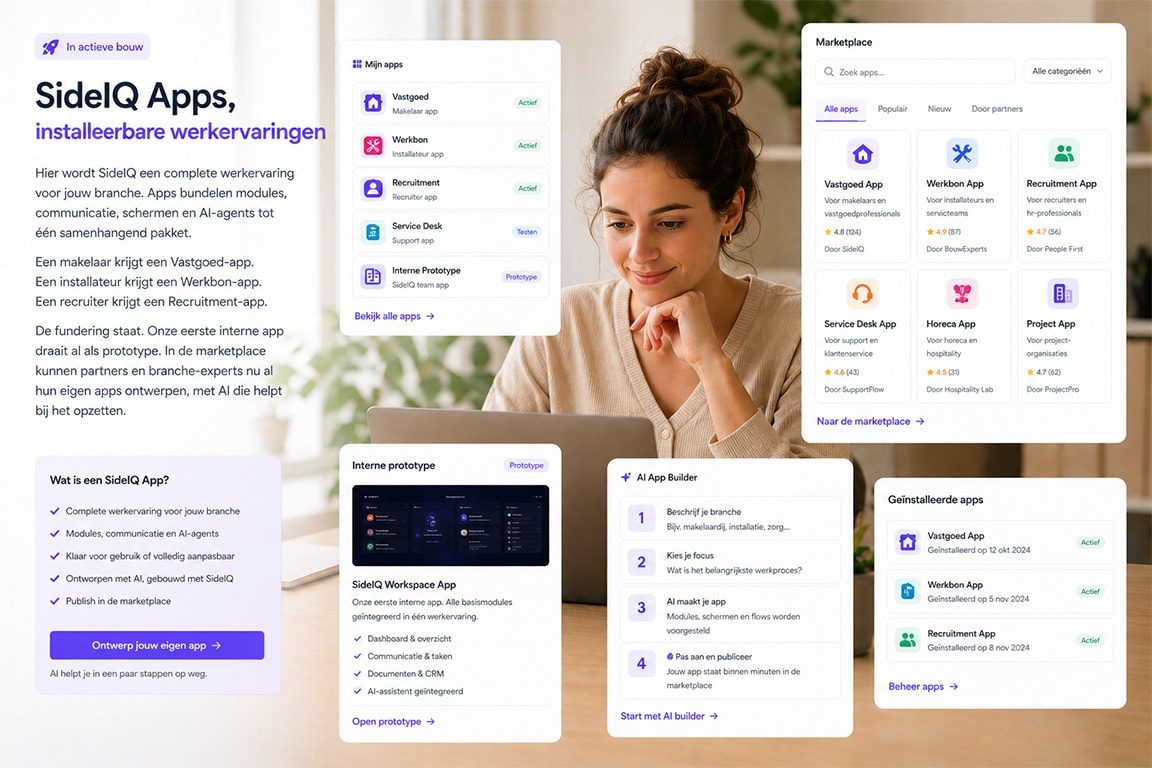
Adaptief / In actieve bouw

No more loose mini-tools. Install a work experience.

SideIQ Apps bring collections, core features, workflows, screens and AI together in one secure work experience. Not a spreadsheet with a nice UI. Not an internal prototype someone must maintain later. But apps that run on the same foundation as your customers, communications, documents, scheduling, quotes, invoices and threads.

First public apps expected from Q3 2026.

Collections and blueprints already lay the groundwork today.

This way you get software that fits your company, without having to maintain a separate custom product in addition to your platform.

SideIQ Apps

What you get

01

Why Apps exist What is a SideIQ App?

Companies increasingly build their own tools. But building software is not the same as running software. With AI tools you can spin up an internal app quickly. That is powerful, but then the real work starts: security, roles, updates, hosting, backups, mobile access, integrations and maintenance. SideIQ Apps feel bespoke, inside a managed environment. You describe how you work. SideIQ provides the structure, the app shell and the connection to everything already happening in your business. A SideIQ App is an installable work experience inside SideIQ. Not a single collection. Not one table. Not one workflow. But a combination of:

02

01 · Collections

Data models for your industry, process or team.

03

02 · Core features

Contacts, companies, communications, documents, quotes, invoices, scheduling and dossiers.

04

03 · Workflows

Steps, actions, statuses and handovers that match how your team works.

05

04 · App shell

Your own navigation, screens, tabs, dashboards and actions per app.

06

05 · AI and agents

Contextual support, prompts, summaries and later managed background tasks.

07

Agents who help

future agents can monitor, prepare, match, follow up or perform work within the same context

08

Context for the SideIQ brain

the AI ​​not only understands individual data, but also how your company actually works

ADAPTIVE · SIDEIQ APPS · ROADMAP

Managed Apps geven bedrijven de vrijheid van eigen software, maar binnen SideIQ's veilige en verbonden omgeving met klanten, dossiers, communicatie, planning, documenten en AI.

SideIQ Apps

Why this is different

01

Vibe-coded internal tool

You get something working quickly, but often without a solid foundation. Think separate hosting, separate databases, a thin permission model, no audit trail, no backups, no maintenance plan and no natural link to real customer data.

02

SideIQ App

Your app runs inside SideIQ. Auth, roles, teams, threads, activities, mobile access, security, updates and integrations are already in the platform. A work order can tie to a customer, a phone call, a quote, an invoice and a dossier without extra glue code.

03

The difference

A standalone tool often stays frozen code. A SideIQ App gets richer as your team uses it. Every action, note, customer question, invoice, appointment and handover feeds organizational memory. That is how SideIQ can keep improving search, summarization, follow-up and automation.

Why this is necessary

Your company doesn't work like a standard template

Without adaptive work apps, companies must choose between two extremes. Either you adapt your process to standard software, or you build separate tools and custom apps that become increasingly disconnected from your core systems.

That's exactly where a lot of software falls short. Self-built apps often lack a solid foundation for rights, security, communication, documents and maintenance. Standard software lacks the flexibility to really connect to how your company works.

Managed Apps are therefore part of the Business Operating System of SideIQ. You build your own work experiences on top of the same customers, files, communication, planning, documents, rights and AI context. The more processes within SideIQ come together, the better the SideIQ brain understands how your business works and where agents can help. This way you get software that feels like customization, without the disadvantages of a separate custom platform.

Examples

Work order app

Field service, inspections, photos, advice, customer sign-off and invoicing.

Real estate app

Listings, viewings, bids, documents, relationships and follow-up.

Recruitment app

Candidates, clients, vacancies, conversations, documents and placements.

Project app

Tasks, phases, subtasks, dossiers, scheduling and team handover.

Industry apps

Roadmap for construction, installation, marketing, wholesale and service businesses.