AI that understands your business



Many entrepreneurs are not "too busy" because there is too much work, but because all the work still routes through them. Here is how you move tasks, context, and follow-up out of your head and back into the business.
Your business is doing quite well.
Customers come back. Turnover is healthy. Your team is doing its best. Maybe you have an assistant in the office, a few people in implementation, or just a network of freelancers that you can rely on.
And yet you are still checking in the evening.
Let's see if that quote is out. Just check whether that customer has been called back. Let's find out exactly what was agreed. Just explain to someone where that one document is.
Not because no one can do anything.
Because you have become the system.
The status of that one customer is in your head. You know the reason that the quotation has not yet been sent. The appointment that actually had to be moved is somewhere in WhatsApp. You'll remember the context behind that billing question if someone lets you talk long enough.
That feels normal.
Until you're sick. Or want to go on holiday. Whether someone else should take over the work.
Only then will you see how much work was not in your company, but in you.
Being busy is often not a capacity problem
Many entrepreneurs think they are busy because there is too much work.
Sometimes that's true. But often there is something else going on.
The work is not too much. The work is too dependent on you.
You are the one who knows where something is. You are the one who still knows why something was agreed this way. You are the one who knows the exceptions, remembers customer preferences, monitors the order and ties up the loose ends.
That seems valuable. And honestly, it is.
However, it is not a scalable way to run your business.
Because if you are always needed to retrieve the context, your company will not have a good memory. Then your company has you.
BOS would say:
If you have to remember everything, your company is not organized. You are organized.

And that is exactly the problem.
You cannot manage work that you cannot see
You can only manage a company if you can see where the work is.
Not approximately. Not by feeling. Not by asking three people if "everything is still running".
Simply visible.
Which customers are waiting for a response? Which offers are open? Which invoices have expired? Which tasks are linked to which file? What agreement was made during that telephone conversation? Which documents belong to this customer?
If that information is spread across email, WhatsApp, Excel, individual tasks, your agenda and your head, you have no overview. You have reconstruction work.
And reconstruction work almost never feels like work.
It feels like "just searching". Scroll back a bit. Just ask. Just call. Let me explain again.
But together that's exactly where your evenings disappear.
WhatsApp is useful, but no working memory
WhatsApp is fantastic for quickly arranging something.
It's just a bad place to keep work.
A customer sends something. You respond. Someone from your team will later ask you what happened. You scroll back. Maybe you'll find it. Maybe it was in another chat. Maybe it was by email after all. Maybe you had discussed it verbally.
And then the real problem begins.
Not that WhatsApp is bad. But that work without a fixed location always comes back to the person who remembers it.
That's you.
A task in WhatsApp is not a task. It's a future search.
A decision in a casual chat is not decision making. It's context loss with delay.
A transfer without a file is not a transfer. It's a gamble that someone else can read your head.
Work must live where it belongs.
At the customer. With the quotation. With the invoice. At the task. At the file. At the flow.
Not somewhere between "can you still watch this?" and a photo of a work order.
Don't talk about work. Talk at work.
Most teams communicate enough.
They just communicate in the wrong places.
A question about a quote is in WhatsApp. A decision about planning will be sent by email. A comment about a customer is in a notebook. A change in scope is discussed verbally. A task is in a separate project management system.
Everyone said something. No one updated the company.
Therefore, the solution is not: communicate more.
The solution is: communicating where the work lives.
Do you have a question about a quote? Include it with the quotation. Has something been agreed with a customer? Record it in the customer file. Does anyone need to follow up? Make it visible as a task with an owner. Is there context to an invoice? Do not put it in a separate chat, but with the invoice.
Then no one has to ask later: "Where did we discuss this again?"
The answer is where it belongs.
A task without an owner is just a wish
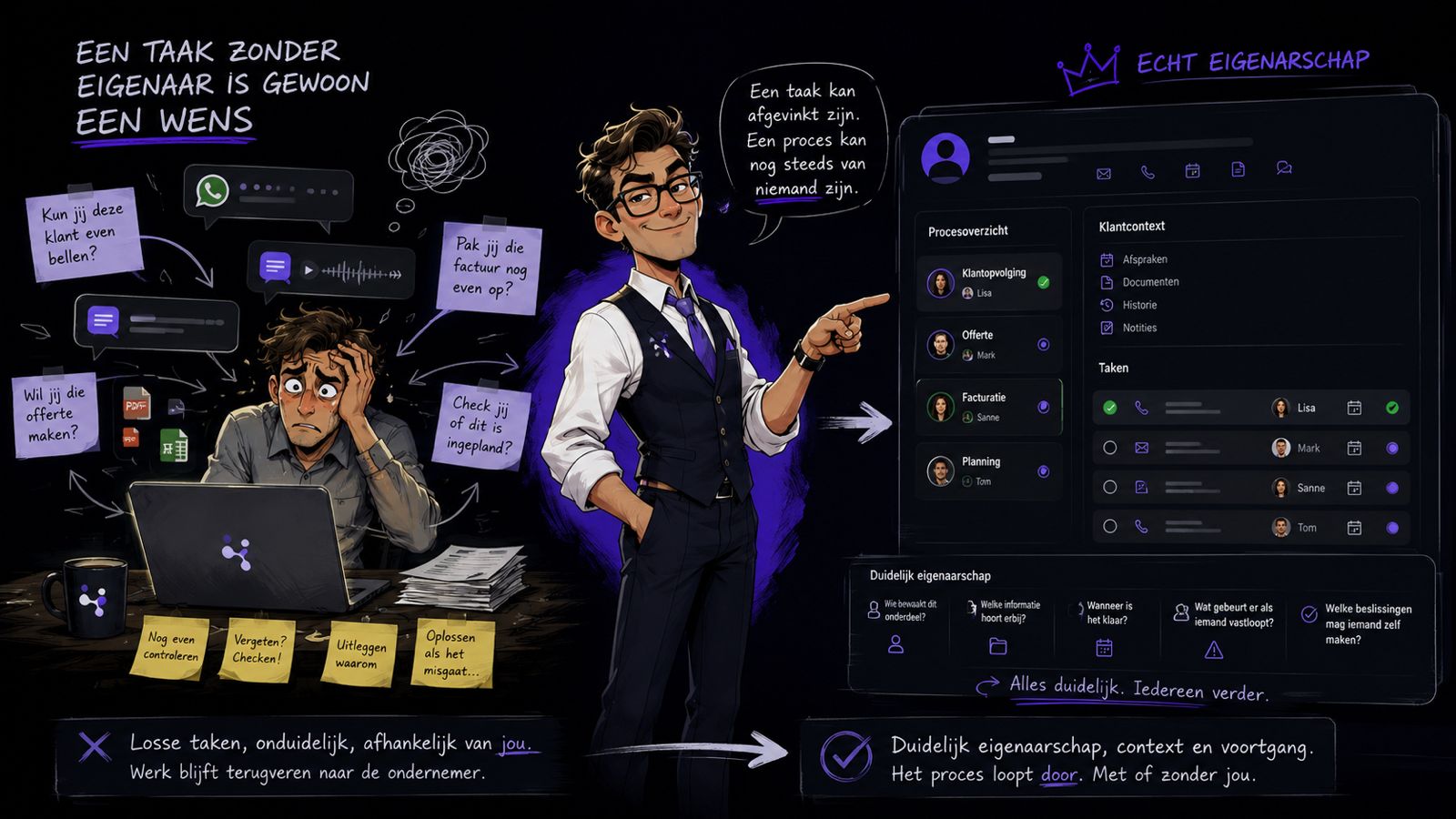
Many entrepreneurs think they delegate.
In reality, they divide individual tasks, but maintain the process themselves.
"Can you please call this customer?" "Do you want to make that quote?" "Will you pick up that invoice?" "Are you checking to see if this has been scheduled?"
That seems like delegation.
But if you still have to make sure it happens, remember what the intention was, explain why it's important, and fix it if it goes wrong, then the process is still yours.
Then only the implementation is outsourced for a while.
True ownership goes beyond assigning a task to someone's name.
It means that it is clear:
Who monitors this part? What information is included? When will it be ready? Where is the progress? What happens if someone gets stuck? What decisions can someone make for themselves?
Without that clarity, work continues to bounce back to the entrepreneur.
Not because people don't want to help. But because the system does not carry enough.
BOS would say:
A task may be checked off. A process still cannot belong to anyone.
Your company must be able to find what you meant without you
This may sound harsh, but it is a good test.
Can someone else see what you meant tomorrow?
Not after you explain. Not after someone calls you. Not after you forward three old emails.
Simply by opening the file.
If the answer is no, the context is not yet in your company.
Then he is inside you.
And as long as context is in you, you cannot truly be free from work. You can go away for a while, but the work travels with you. In your head. In your phone. In that slight feeling of unrest that you just have to take a look.
That is why better organization is not about working more neatly.
It's about transferable work.
Work that is transferable can continue. Work that is visible can be controlled. Work that has context can be picked up by someone else. Work that is in the system does not have to stay in your head.
Don't open your inbox. Open your business.
The first tab of your day often determines who controls your day.
If you start in your inbox, then you start responding.
At the request of a customer. On someone else's reminder. To something loud enough to be on top.
That feels productive, but it is often reactive.
An entrepreneur needs something different.
A place where you see what requires attention today. Not just who just emailed you, but what is operationally important.
Which customer has been waiting too long? Which quotation should be followed? Which invoice is overdue? Which appointment requires preparation? What task is someone else blocking? Which signals does the system see before you see them yourself?
That is the difference between adjusting and directing.
Adjustment means correcting afterwards. Rather, directing means seeing what needs attention.
That's why your day shouldn't start with random messages.
Your day should start with your business.
Where SideIQ comes in
SideIQ is built from one simple idea:
Your company does not work in separate tabs. So your system shouldn't do that either.
A customer is not just a contact. A customer has conversations, quotes, invoices, documents, tasks, appointments, notes, follow-up and history.
A quotation is not just a PDF. There is communication before, context during and follow-up after.
An invoice is not just administration. It is part of the relationship, the cash flow and the agreement that preceded it.
That is why SideIQ brings together work around files and flows.
Not so that you have more software.
Precisely so that you have to reconstruct less.
The SideIQ brain can only think usefully if the context remains together. When customer conversations, documents, tasks, quotes and follow-up are all in separate places, AI has to guess just like you. But if the work lives in one coherent system, SideIQ can help prepare, summarize, signal and follow up.
Not magical.
Simply because the company becomes more readable.
And the longer you work like this, the more context SideIQ builds. About your customers, your files, your team, your processes and your way of working. That is the real value of a Business Operating System: not another screen, but a company that manages itself better and better.
The simple test
Do you want to know if you are still the workflow?
Ask yourself these seven questions.
- Can anyone else see which customers need attention today?
- Can someone else follow up on a quote without asking you what has been agreed?
- Can anyone else see why an invoice is still open?
- Can someone else find the latest customer communication without looking at your phone?
- Can someone else pick up a task with enough context to complete it well?
- Can anyone else see who owns a process, not just a task?
- Can you go away for a week without your company going on pause?
If the answer is often no, you don't have a people problem.
You have a system problem.
And that is good news.
Because changing people is difficult. Demanding more discipline usually only works for a while. Adding another separate tool often only makes the stack higher.
But make work a better place to live?
You can solve that.
Lock
You don't have to work harder to gain more control.
You should have to remember less.
Search less. Explain less. Less scrolling back. Less reconstruction. Putting out fewer fires that were actually just a loss of context.
You are not the workflow.
You are the entrepreneur.
Let the system carry what the system must carry.
Then you can do what you were meant to do again: manage.
Don't keep being everything yourself.